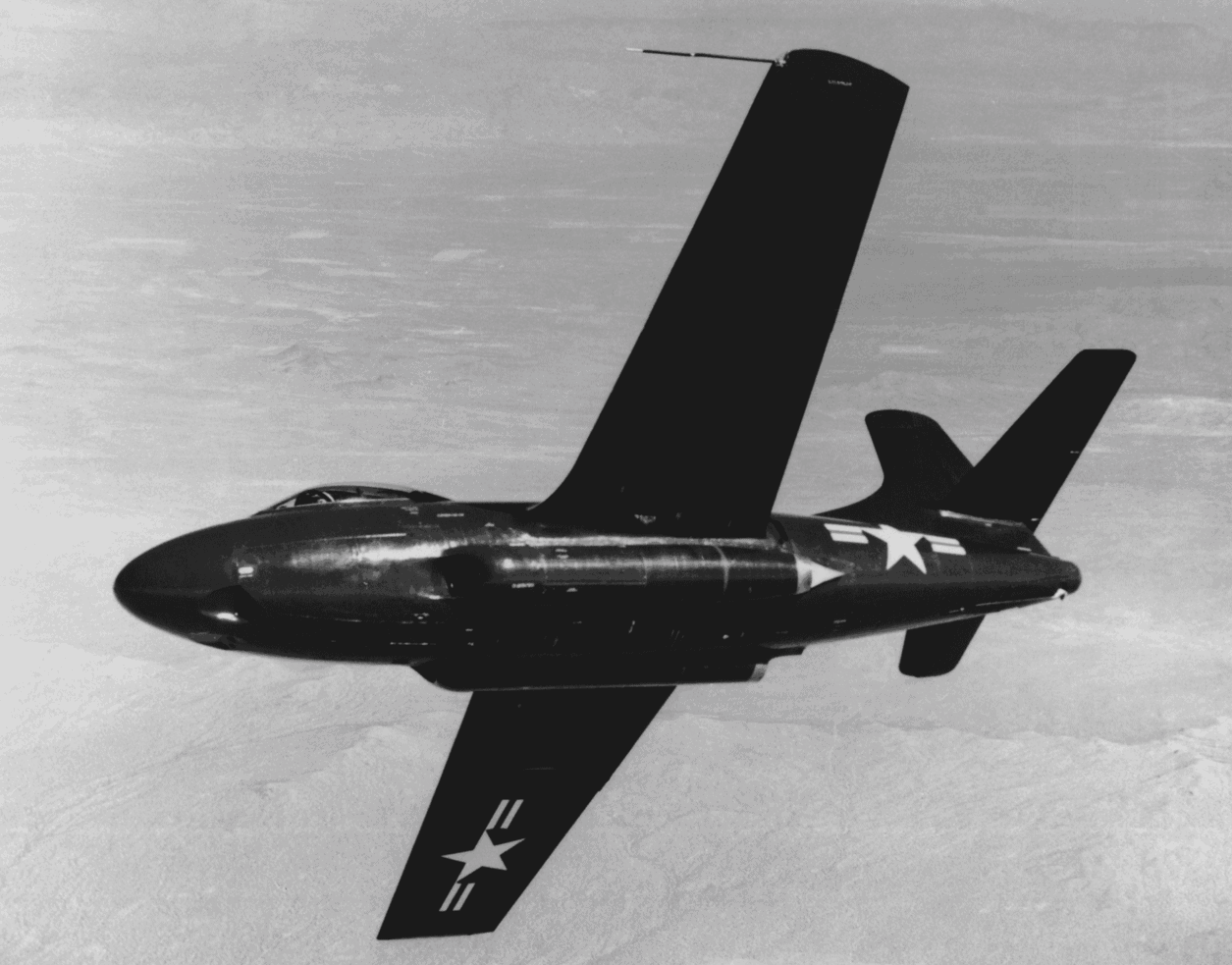
Douglas F-10B Skyknight, BuNo 125850
Museum Restoration Storage, Edwards AFB
The Douglas F-10B Skyknight was a U.S. Navy twin-engine, carrier-based jet aircraft developed in the late 1940s as part of the Navy’s transition into all-weather jet operations. Originally designated the F3D-2, the aircraft was redesignated F-10B in 1962 under the Tri-Service aircraft designation system. Designed by Douglas Aircraft Company, the Skyknight emphasized endurance, stability, and systems integration over speed or maneuverability, reflecting its primary role as a night and all-weather interceptor during the early Cold War.
Distinctive for its side-by-side crew seating, the F-10B paired a pilot with a radar operator to manage one of the Navy’s earliest airborne intercept radar systems. Powered by two Westinghouse J34 turbojet engines, the Skyknight featured straight wings, a robust airframe, and a large nose radome housing its radar. While not fast compared to contemporary fighters, its predictable handling, long loiter time, and heavy armament—typically four 20 mm cannons—made it well suited for radar-guided interception and night combat operations from aircraft carriers.
The Skyknight earned its combat reputation during the Korean War, where it became the U.S. Navy’s most successful jet night fighter, credited with several enemy aircraft kills, including jet-versus-jet victories under radar control. Beyond its interceptor role, the F-10B later proved adaptable as an electronic warfare and test platform, influencing subsequent Navy EW aircraft such as the EA-3 Skywarrior. Though overshadowed by faster supersonic fighters that followed, the Douglas F-10B Skyknight remains significant for pioneering naval radar interception and demonstrating the importance of crew coordination and systems integration in modern air combat.