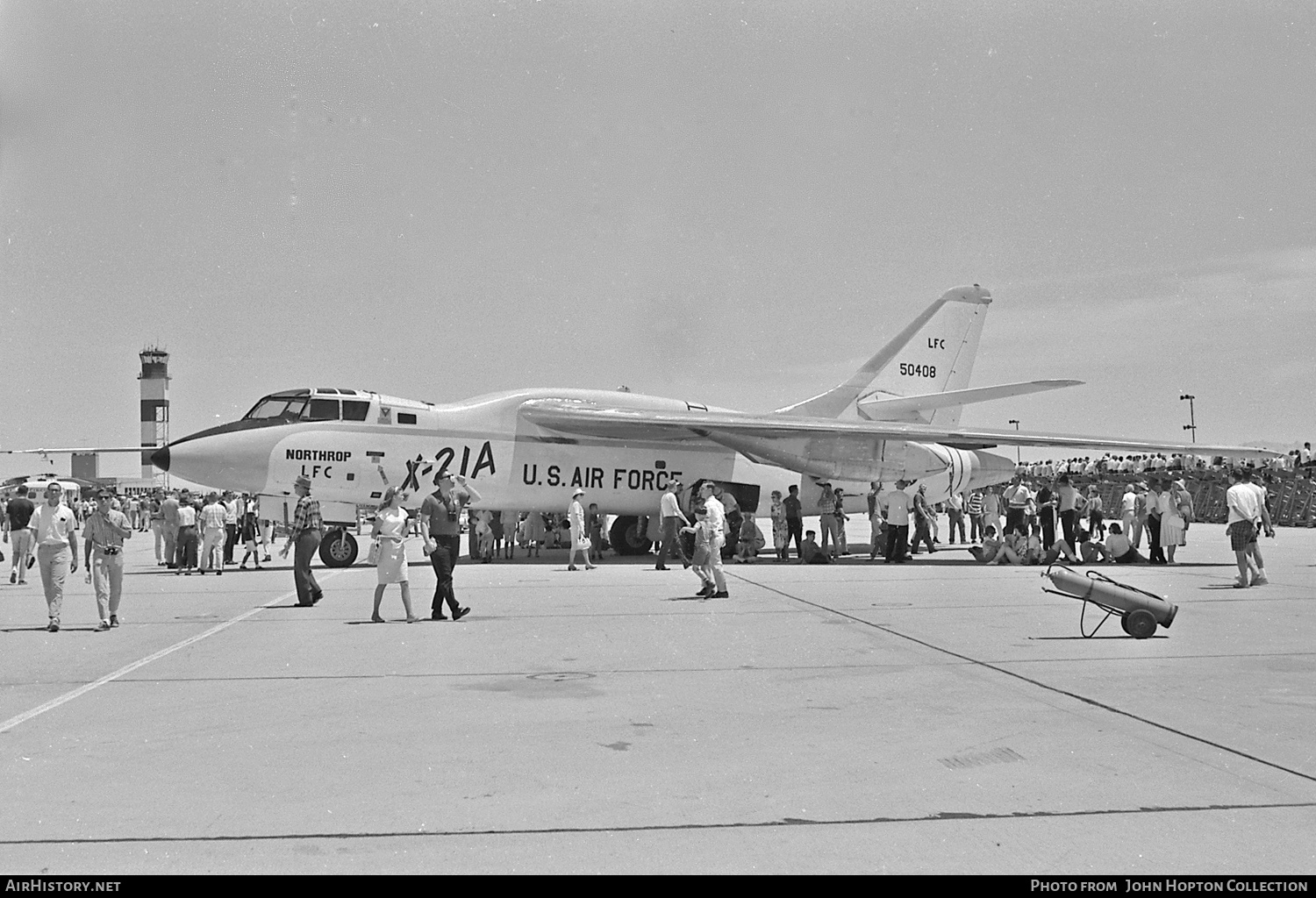
Northrop X-21, S/N 55-408
Museum Storage, Edwards AFB
The Northrop X-21 was a highly specialized research aircraft developed in the early 1960s by Northrop Corporation in collaboration with the U.S. Air Force and NASA. It was created to investigate laminar flow control (LFC), an advanced aerodynamic concept aimed at reducing drag by maintaining smooth, orderly airflow over an aircraft’s wings. The X-21 was derived from the Douglas WB-66D Destroyer, which was extensively modified with new wings and systems designed specifically for experimentation rather than operational use.
The defining feature of the X-21 was its porous wing surface, which used thousands of tiny perforations connected to an internal suction system. This system actively removed a thin layer of air from the wing surface to delay the transition from laminar to turbulent flow, significantly reducing drag at higher speeds. In theory, this could lead to improved fuel efficiency, longer range, and better overall performance for future aircraft. The program conducted numerous flight tests to evaluate how well laminar flow could be maintained under real-world conditions, including exposure to contaminants such as dust, insects, and surface imperfections.
Although the X-21 successfully demonstrated that laminar flow control was feasible, it also revealed major practical challenges. The system proved to be highly sensitive to surface contamination and required extremely smooth, clean wing surfaces to function effectively—conditions difficult to maintain in everyday operations. As a result, technology was not widely adopted at the time. However, the data gathered from the X-21 program provided valuable insights that continue to influence modern aerodynamic research, particularly in the development of more practical natural laminar flow designs used in contemporary high-efficiency aircraft.