
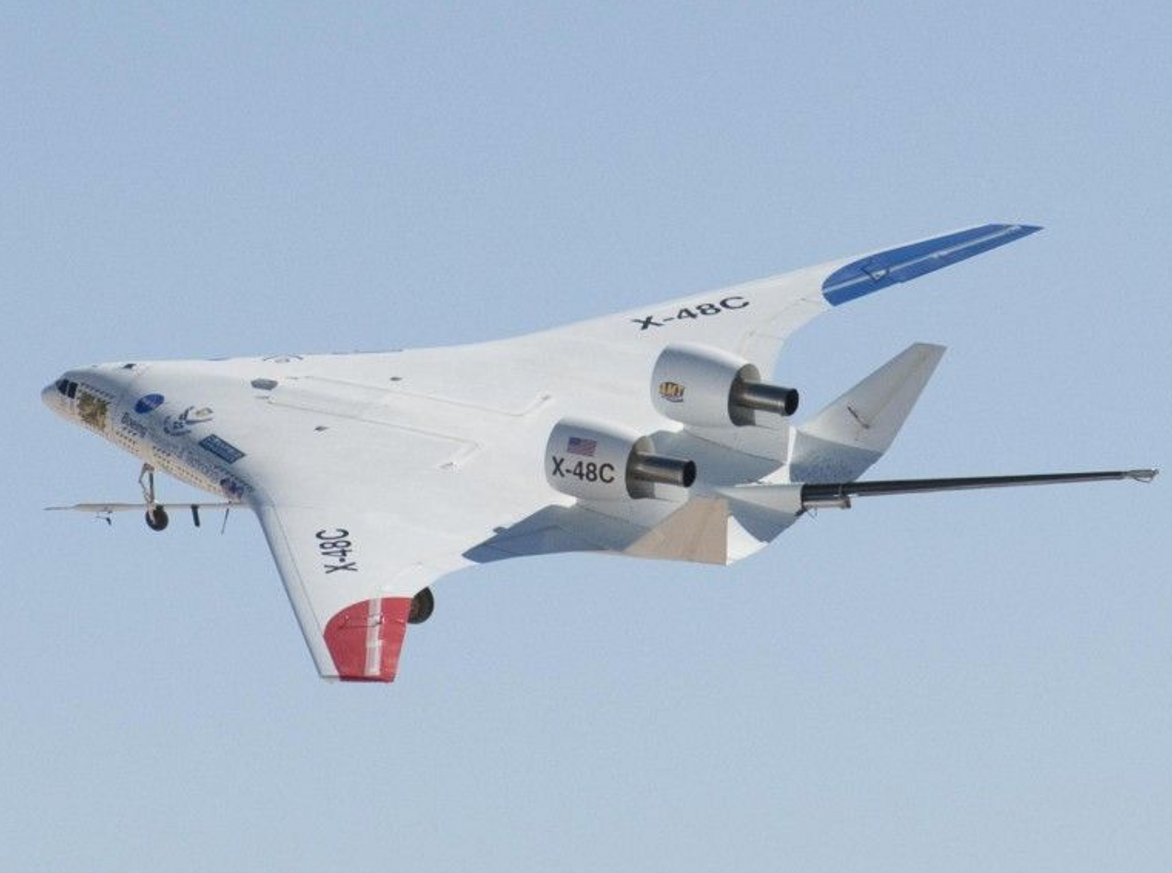
Boeing X-48C Blending Wing
The Boeing X-48C was an experimental blended wing body (BWB) aircraft developed by Boeing Research & Technology in partnership with NASA and the U.S. Air Force Research Laboratory (AFRL) to explore a radically different approach to aircraft configuration. Building on the earlier X-48A and X-48B demonstrators, the X-48C was a subscale, remotely piloted research vehicle designed to examine how a tailless, wide lifting body could improve aerodynamic efficiency, stability, and environmental performance compared to conventional tube-and-wing aircraft. The program focused on validating design tools and control laws needed for future large-scale BWB transport and special-mission aircraft.
Compared to its predecessors, the X-48C featured a reconfigured planform with a reduced vertical tail and modified wing shape, optimized for lower-speed flight regimes such as takeoff and landing. These changes allowed researchers to study low-speed handling qualities, stall behavior, and yaw control—historically challenging areas for tailless aircraft. The vehicle was powered by three small jet engines mounted on the upper aft surface, a configuration that also supported research into noise shielding, as the airframe could block engine noise from reaching the ground—an important consideration for future environmentally responsible aircraft.
Flight testing of the X-48C was conducted at NASA’s Dryden Flight Research Center (now Armstrong) and provided critical data on flight control robustness, aerodynamic efficiency, and scalability of the blended wing concept. While the X-48C itself was not intended for operational service, the insights gained influenced subsequent studies into next-generation military transport, tankers, and high-efficiency commercial aircraft, including concepts aimed at reduced fuel burn and emissions. The X-48C program remains a landmark in modern experimental aviation, demonstrating that blended wing designs are both controllable and viable for future aerospace applications.