
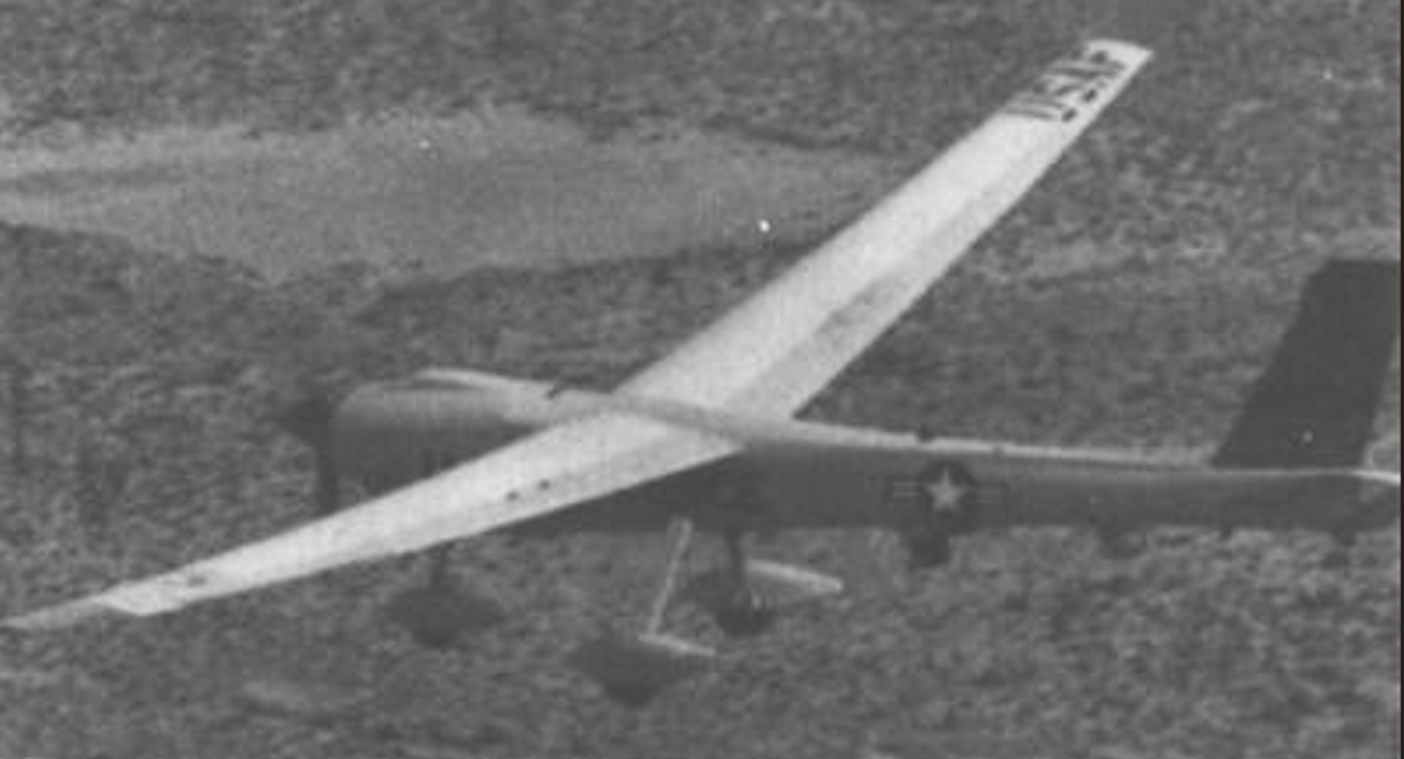
Martin Marietta MMC-845
The Martin Marietta MMC-845, more commonly referenced as the Martin Marietta Model 845, was a U.S. remotely piloted aircraft developed in the late 1960s and early 1970s by the American aerospace manufacturer Martin Marietta Corporation. It was designed under the United States Air Force Compass Dwell program as a high-endurance communications relay drone, intended to provide long-duration airborne relay capability for operations such as those in the Vietnam War. The Model 845 drew on the airframe of the Schweizer SGS 1-34 sailplane, resulting in a glider-like configuration optimized for efficient flight. The first prototype made its maiden flight in April 1972, demonstrating impressive endurance by remaining aloft for nearly 28 hours during testing.
Despite showing potential, the program did not meet all the Air Force’s requirements, particularly the specified service ceiling, and was ultimately cancelled in 1973 along with competitor designs like the Ling-Temco-Vought XQM-93. The cancellation of the Model 845A (an improved variant) led to the Compass Dwell effort being superseded by the related Compass Cope program. After cancellation, a couple of the airframes survived: two were transferred to New Mexico Tech’s Langmuir Laboratory for Atmospheric Research, where one was modified into a piloted research aircraft (SPTVAR) and used for atmospheric experiments through the late 1990s, including flying through thunderstorms to measure electric fields. (Source: Wikipedia)