
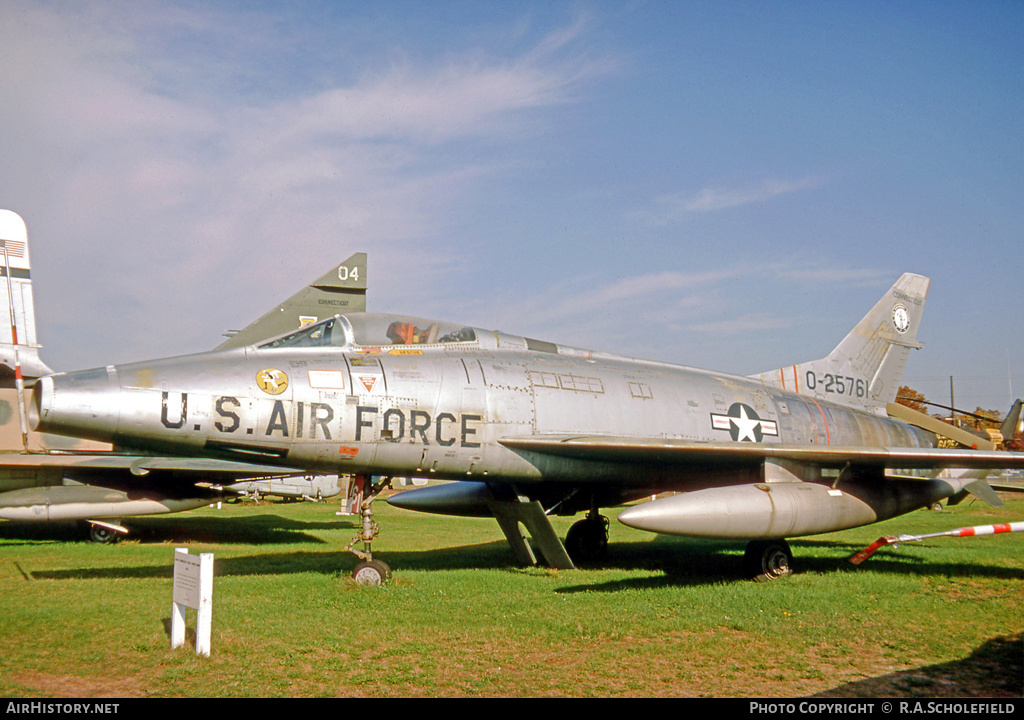
North American F-100A Super Sabre, S/N 52-5760
The North American F-100A Super Sabre was the first production fighter in the U.S. Air Force capable of sustained supersonic speed in level flight, marking a major milestone in jet aviation. Developed by North American Aviation in the early 1950s, the F-100A was designed as a successor to the F-86 Sabre, incorporating a swept wing, more powerful afterburning turbojet engine, and advanced aerodynamics. It represented the transition from transonic fighters to true supersonic performance, pushing the boundaries of speed, stability, and pilot control.
Despite its groundbreaking capabilities, the F-100A encountered significant early operational challenges. Pilots experienced issues with stability, particularly at high speeds and during certain maneuvers, leading to several accidents and earning the aircraft the nickname “Sabre Dance.” These problems were largely attributed to aerodynamic characteristics and control limitations that were not fully understood at the time. As a result, the F-100A had a relatively short frontline service life, and many were either modified or replaced by improved variants such as the F-100C and F-100D, which incorporated design refinements and enhanced mission capabilities.
Although the F-100A itself was limited in long-term service, it played a crucial role in advancing supersonic fighter design and pilot training. The lessons learned from its development and early operational use directly influenced later aircraft and improvements in flight control systems. The broader F-100 Super Sabre family went on to serve extensively during the Vietnam War, primarily in ground-attack roles. The F-100A’s legacy lies in its pioneering achievement as the Air Force’s first true supersonic fighter and its contribution to the evolution of modern high-performance jet aircraft.