
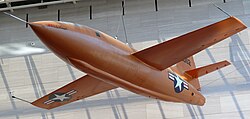
Bell X-1 (Mock-up)
The Bell X-1 was developed in the mid-1940s as a joint effort between the U.S. Army Air Forces and the National Advisory Committee for Aeronautics to explore the unknown and dangerous region of transonic flight. At the time, engineers and pilots faced the so-called “sound barrier,” where aircraft encountered severe aerodynamic instability as they approached the speed of sound. Built by Bell Aircraft, the X-1 featured a bullet-shaped fuselage inspired by a .50-caliber projectile, extremely thin wings, and a rocket engine designed to deliver the thrust needed to push beyond Mach 1.
The program reached a historic milestone on October 14, 1947, when test pilot Chuck Yeager flew the X-1—nicknamed Glamorous Glennis—to a speed of Mach 1.06 at an altitude of about 45,000 feet. This flight marked the first time a human had officially traveled faster than the speed of sound in level flight, successfully breaking the sound barrier. The X-1 was carried aloft by a modified B-29 Superfortress and released midair before igniting its rocket engine. Yeager’s achievement not only proved that supersonic flight was possible but also provided critical data on stability, control, and aerodynamic behavior in the transonic and supersonic regimes.
Following this breakthrough, the Bell X-1 program continued with several variants, including the X-1A and X-1B, which pushed speeds even higher and expanded research into high-speed flight dynamics. The data gathered from these flights directly influenced the design of future supersonic and high-performance aircraft, including early jet fighters and later spacecraft. The X-1 program laid the foundation for modern aeronautics and space exploration, ultimately contributing to advancements that would carry aviation from the edge of the sound barrier to the threshold of space.