
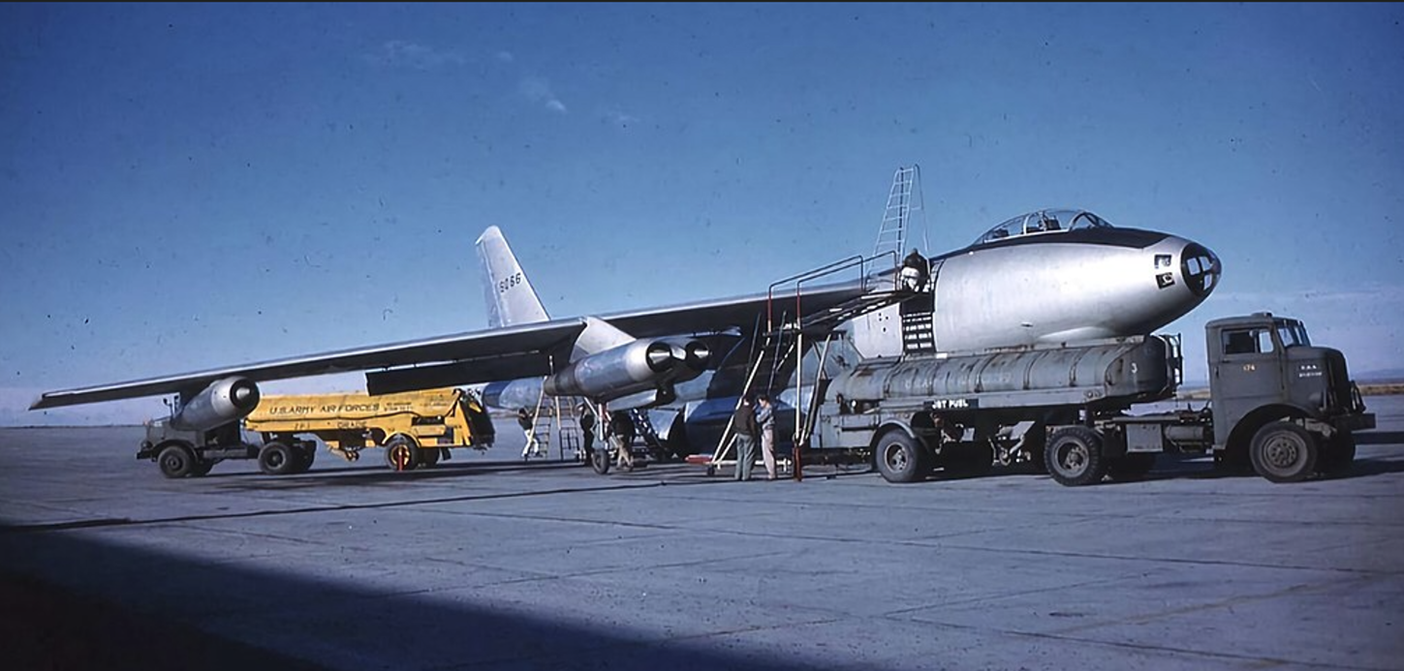
Boeing XB-47 Stratojet
The Boeing XB-47 Stratojet was a revolutionary prototype that fundamentally reshaped military jet aircraft design and laid the groundwork for the United States’ Cold War bomber force. First flown in December 1947, the XB-47 emerged from a post–World War II requirement for a fast, high-altitude, long-range bomber capable of delivering nuclear weapons. Boeing’s design team, influenced by captured German research on swept wings and high-speed aerodynamics, produced an aircraft that departed radically from piston-engine bombers, signaling the U.S. Air Force’s transition into the jet age.
The XB-47 introduced several groundbreaking features that became aviation standards. Its 35-degree swept wings, six turbojet engines mounted in under-wing pods, and bicycle landing gear with outrigger wheels were unprecedented in bomber design. These choices reduced drag at high subsonic speeds and enabled efficient high-altitude flight, while the engine placement simplified wing structure and maintenance. The aircraft’s sleek, minimalist fuselage reflected a focus on speed and altitude rather than defensive armament, relying instead on performance to evade enemy interceptors.
Although only two XB-47 prototypes were built, their success led directly to the production of the B-47 Stratojet, which became the backbone of the Strategic Air Command during the 1950s. The XB-47’s influence extended far beyond its own program, shaping later aircraft such as the B-52 Stratofortress and informing swept-wing design across both military and commercial aviation. As a result, the XB-47 is widely regarded as one of the most influential experimental aircraft in aerospace history, marking a decisive shift toward modern jet-powered, high-speed flight.