
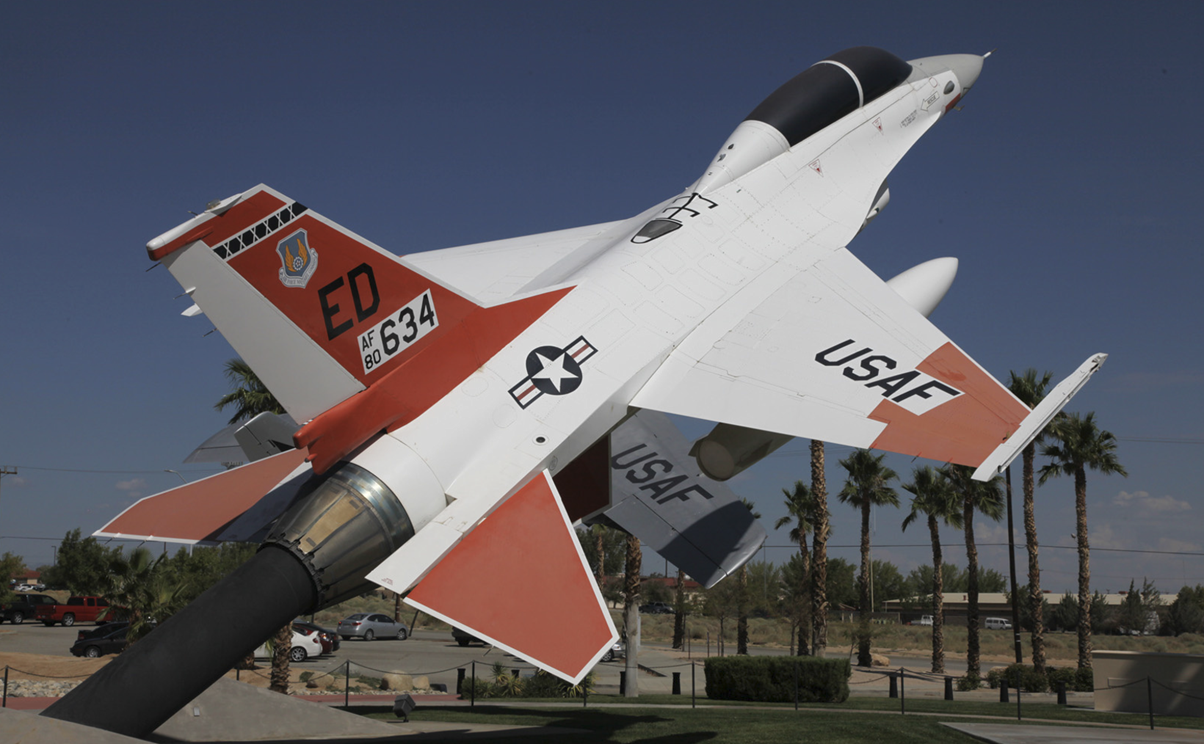
General Dynamics F-16B Fighting Falcon S/N 75-0751
The General Dynamics F-16 Fighting Falcon was born in the early 1970s from the U.S. Air Force’s Lightweight Fighter program, shaped by lessons learned during the Vietnam War. The goal was to create a smaller, highly maneuverable, and more affordable complement to the larger F-15 Eagle. General Dynamics’ YF-16 prototype won the competition in 1975, introducing revolutionary features such as fly-by-wire controls, relaxed static stability, a bubble canopy for unmatched visibility, and a side-stick controller. These innovations gave the aircraft exceptional agility and pilot awareness, setting a new standard for fighter design.
Entering operational service in 1978, the F-16 was initially intended as a day air-superiority fighter, but it quickly evolved into a true multirole platform. Through successive “block” upgrades, it gained advanced radar systems, night-attack capability, precision-guided munitions integration, and specialized suppression of enemy air defenses (SEAD) roles. The aircraft proved itself in major conflicts including Operation Desert Storm, and it became a cornerstone of U.S. and allied airpower. Production later transitioned from General Dynamics to Lockheed Martin, ensuring continued modernization and global support.
With more than 4,600 aircraft produced and service in over 25 nations, the F-16 remains one of the most successful and widely operated fighter aircraft in history. Its adaptability has allowed it to transition from Cold War air combat to precision strike, close air support, homeland defense, and advanced training roles. Today, the latest variants such as the F-16V continue to incorporate modern avionics and AESA radar, proving that a design conceived over five decades ago still delivers relevance, reliability, and combat effectiveness in the modern battlespace.