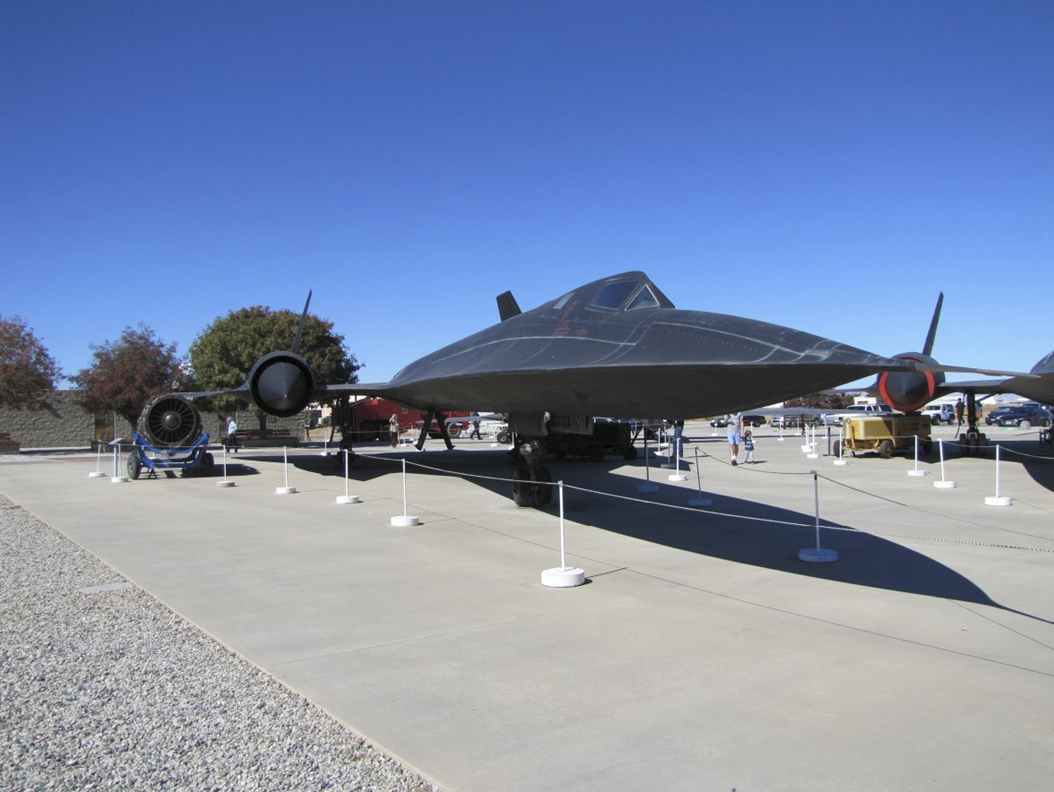
Lockheed Martin SR-71 Blackbird, S/N 61-7955
The SR-71 was the USAF’s two-seat version of the CIA’s A-12 reconnaissance aircraft. Capable of the same high speed and altitudes as the A-12, it was slightly heavier due to the increased camera/radar sensor payload, which is housed in the interchangeable nose and fuselage bays. the aircraft had an empty weight of 30 tons and carried 40 tons of fuel when full.
Lockheed Skunk Works Chief Test Pilot, Robert J. “Bob” Gilliland flew the maiden flight on December 22, 1964. The first SR-71 flight took place at Air Force Plant 42 in Palmdale, California, on 22 December 1964. The SR-71 reportedly reached a top speed of Mach 3.4 during flight testing, with its most efficient cruise speed being Mach 3.2.
Hundreds of SAMs were fired at Blackbirds during their operational careers, with no aircraft losses resulting from being hit by the missiles because SR-71 was protected by a suite of electronic countermeasures, and because it was simply able to outfly them.
A total of 32 SR-71s were built, with 29 SR-71As, two SR-71Bs, and the single SR-71C. The SR-71 was in service from 1964 to 1998, when it was finally retired due to budget cuts. Twelve SR-71s were lost and one pilot died in accidents during the aircraft’s service career. No aircraft were ever lost due to enemy action.
The first SR-71 to enter service was in January 1966. Operational SR-71 aircraft were assigned to the 9th SSRW at Beale AFB and various detachments. The SR-71 was retired from active duty in 1989, with the SR-71 flying its last missions in October 1989. Due to worsening political conditions in the Middle East and North Korea, the SR-71 program was reactivated in 1993, with three aircraft returned to service by Lockheed. The Air Force permanently retired SR-71 in 1998, leaving NASA with the two last airworthy Blackbirds until 1999.
The fastest recorded speed for the SR-71 was Mach 3.32 (2,193 mph), an official speed record set on 27 July 1976.
On 6 March 1990, SR-71 flight test aircraft #972 set a transcontinental speed record of 68 minutes coast-to-coast on its last mission, when it flew from Palmdale to Washington DC (on display at the Smithsonian Air and Space Museum).
The aircraft on display at the main museum is the 6th prototype, S/N 61-7955. assembly started on 13 May 1964 and #955 first flew on 17 August 1965. Throughout its career, this aircraft served as the premier Palmdale test aircraft by Lockheed and the Air Force, to test new systems and configurations for the rest of the Blackbird Fleet. It carried Lockheed’s famous “Skunk Works” logo on its tail. By the time 955 was retired, the airframe had been modified so many times that it was no longer considered representative of the SR-71 fleet. Last flown on 24 January 1985, #955 accumulated 1993.7 hours of flight time.