
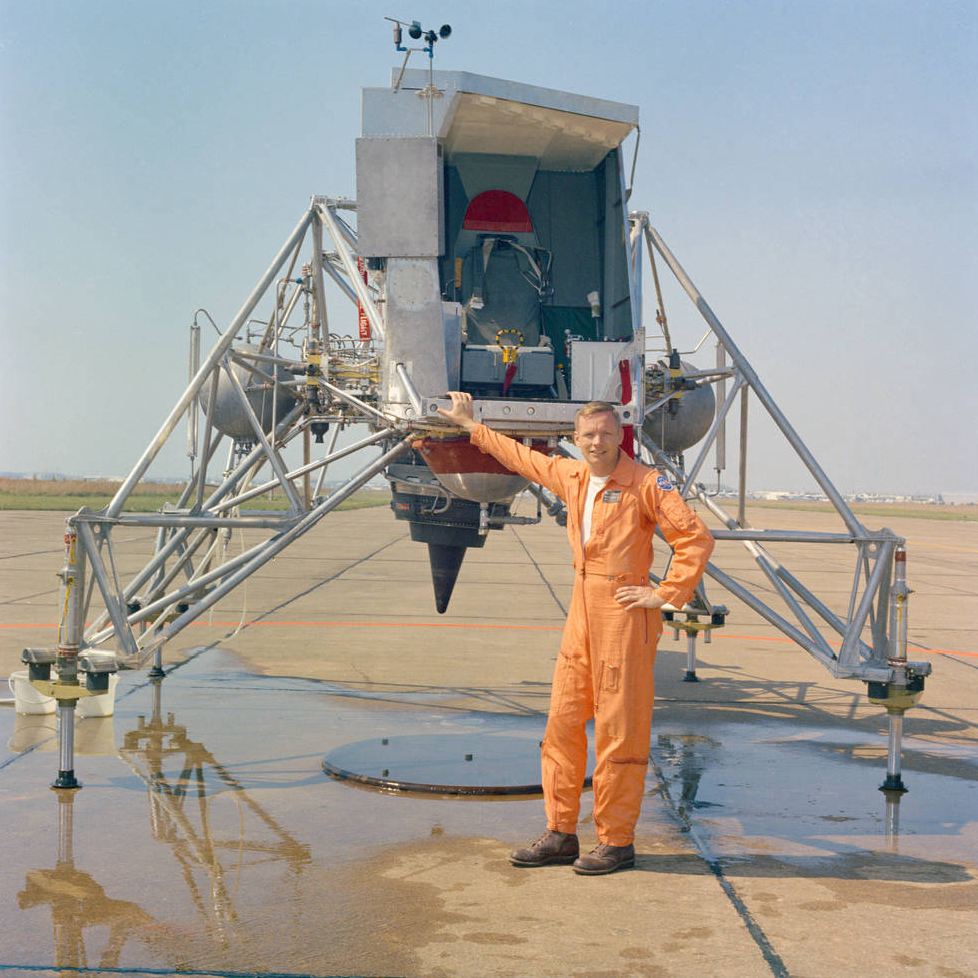
Bell Aerosystems Lunar Landing Research Vehicle No. 2 (LLRV-2)
On Display – Main Museum, Edwards AFB
The Bell Aerosystems Lunar Landing Research Vehicle No. 2 (LLRV-2) was one of two experimental “flying testbeds” NASA used during Apollo to understand—and practice—the unique piloting challenges of landing on the Moon. Built as an open truss “flying frame” (often nicknamed the “Flying Bedstead”), LLRV-2 supported NASA’s flight research at what is now NASA’s Armstrong Flight Research Center at Edwards AFB, helping validate piloting techniques and control behaviors that could not be fully proven in simulators alone.
What made LLRV-2 special was how it simulated lunar gravity in Earth’s atmosphere. A vertically mounted, gimbaled jet engine provided most of the lift—throttled so it effectively “canceled” about five-sixths of the vehicle’s weight, leaving the pilot to manage the remaining “moon-like” weight with control jets. Attitude and translation were handled by hydrogen-peroxide thrusters, while a pioneering fly-by-wire control approach translated pilot inputs through onboard computers into stable, controllable motion—critical for learning how a Lunar Module would feel in the last seconds of descent.
Although the later Lunar Landing Training Vehicles (LLTVs) became the workhorse trainers for astronauts, LLRV-2 remains an important proof-of-concept artifact that helped bridge research, handling-qualities validation, and operational training. Today, LLRV-2 (NASA 951) is preserved and displayed in the museum reflecting the flight-test contribution to Apollo’s landing success and the broader evolution of lunar landing simulation technology.