
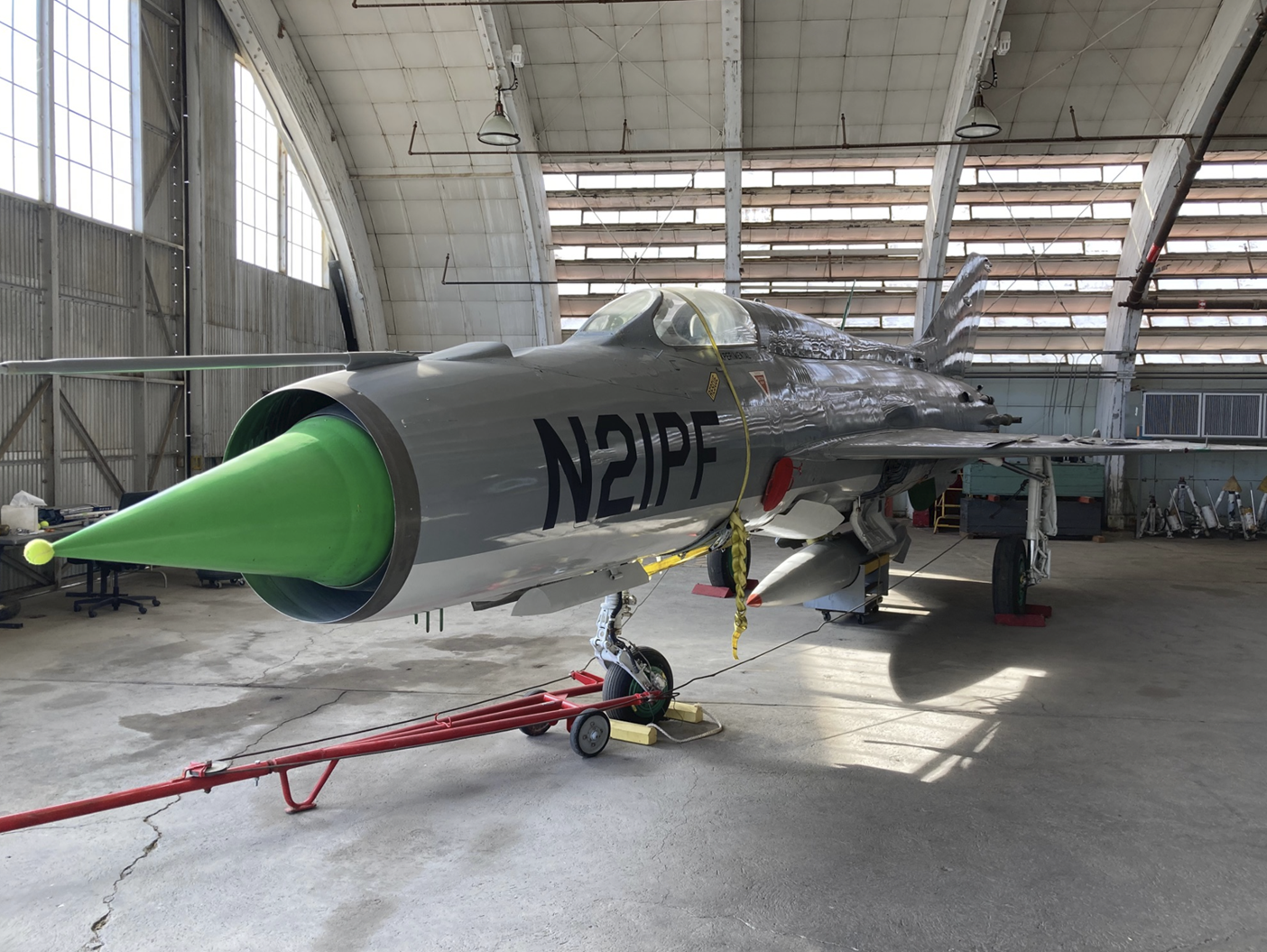
Mikoyan-Gurevich MiG-21PF
Museum Storage, Edwards AFB
The Mikoyan-Gurevich MiG-21PF was an early all-weather interceptor variant of the highly successful MiG-21 “Fishbed,” developed by the Soviet design bureau Mikoyan-Gurevich in the early 1960s. The “PF” designation stands for Perekhvatchik Forsirovannyy (interceptor, uprated), reflecting its role as a radar-equipped air defense fighter. Unlike earlier day-fighter versions, the MiG-21PF incorporated the RP-21 Sapfir radar in its nose, enabling limited beyond-visual-range interception capability under poor weather and nighttime conditions. This made it better suited to fulfill the Soviet Union’s expanding air defense requirements during the height of the Cold War.
To accommodate the radar, the MiG-21PF featured a redesigned nose intake with a shock cone housing the radar antenna. However, in keeping with Soviet doctrine at the time, the internal cannon was deleted in favor of missile armament, typically the K-13 (AA-2 “Atoll”) infrared-guided air-to-air missile. While this aligned with the era’s heavy emphasis on missile combat, operational experience later demonstrated the continued importance of gun armament in close-range engagements. The PF variant retained the MiG-21’s hallmark characteristics—delta wing, lightweight structure, and high speed—capable of exceeding Mach 2, though with relatively short range and endurance.
The MiG-21PF saw widespread service with the Soviet Air Forces and was exported to numerous Warsaw Pact and allied nations. It became a prominent adversary aircraft during the Vietnam War, where North Vietnamese pilots used the MiG-21 effectively in hit-and-run tactics against U.S. aircraft. The PF variant marked a key transitional step in the MiG-21 lineage, moving the design from a simple daytime fighter toward a more capable radar-guided interceptor that would evolve into later, more advanced versions.