
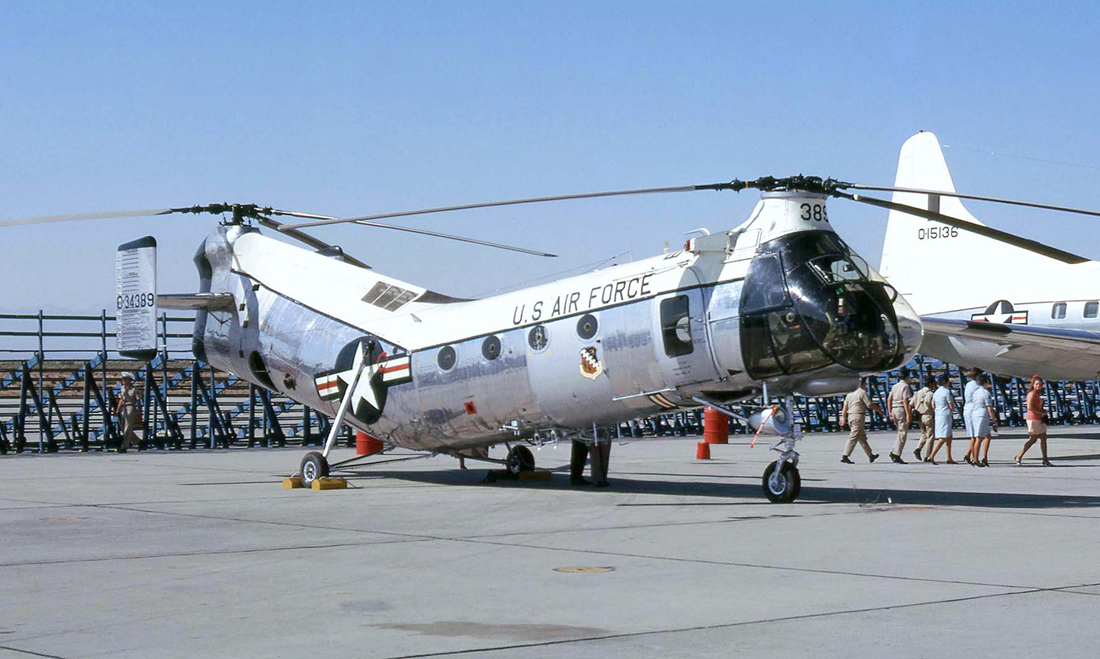
Piasecki H-21B Workhorse, S/N 52-8623
Museum Storage, Edwards AFB
The Piasecki H-21B Workhorse was a tandem-rotor transport helicopter developed in the early 1950s by Piasecki Helicopter Corporation, a company known for pioneering tandem-rotor helicopter technology. The aircraft first flew in 1952 and quickly became recognizable for its curved fuselage, which gave it the nickname “Flying Banana.” This distinctive shape helped keep the large rotor blades clear of the fuselage while allowing the aircraft to carry substantial loads. Originally designed for Arctic rescue and transport missions, the H-21 was built to operate in extremely cold environments and was widely used to support remote radar installations along the Distant Early Warning (DEW) Line during the Cold War.
The improved H-21B variant featured a more powerful Wright radial engine and other enhancements that increased lifting capability and operational flexibility. The helicopter could carry more than twenty fully equipped troops, cargo, or multiple litters for medical evacuation, making it one of the first helicopters capable of meaningful air assault transport operations. During the late 1950s and early 1960s, the H-21 served with the U.S. Air Force, U.S. Army, and several allied nations, performing missions that ranged from troop transport and logistics to search-and-rescue and disaster relief.
The H-21 also played an important role in the early development of helicopter warfare. It was among the first helicopters used by U.S. forces in the early years of the Vietnam conflict, where it demonstrated both the promise and limitations of piston-engine transport helicopters in combat environments. Although it was eventually replaced by newer turbine-powered aircraft such as the Bell UH-1 Huey, the H-21 helped establish the operational concepts for helicopter-borne troop movement. Its tandem-rotor design would later influence larger and more capable helicopters like the Boeing Vertol CH-46 Sea Knight and the CH-47 Chinook, aircraft.