
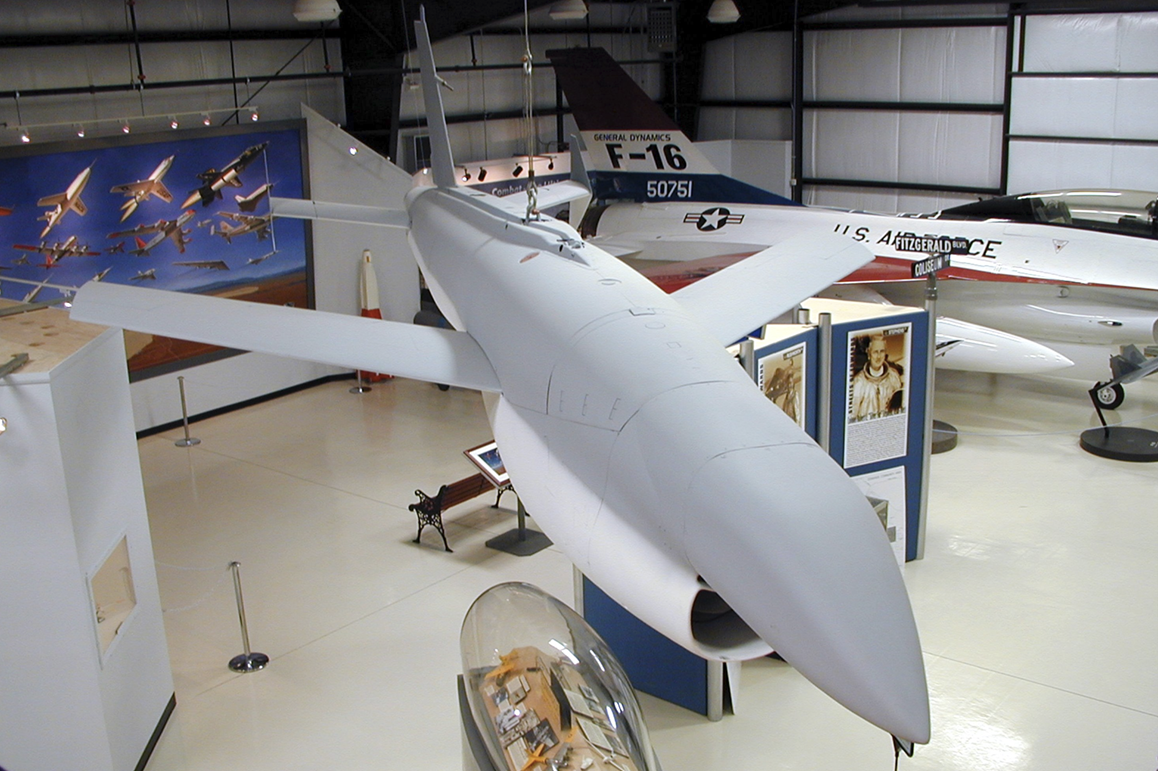
Ryan AQM-34J Firebee
On Display – Main Museum, Edwards AFB
The Ryan AQM-34J Firebee was a variant of the Ryan Firebee series of unmanned aerial vehicles developed by the Ryan Aeronautical Company during the Cold War. Originally derived from the Ryan Firebee target drone of the 1950s, the aircraft evolved into a highly capable reconnaissance platform under the U.S. Air Force’s Lightning Bug program. The AQM-34 series drones were designed to perform high-risk intelligence missions in heavily defended airspace without risking a human pilot. The AQM-34J variant emerged in the late 1960s as an improved reconnaissance version capable of operating at higher altitudes and longer ranges.
During the Vietnam War, the AQM-34J played a significant role in gathering photographic and electronic intelligence over hostile territory, particularly over North Vietnam and nearby regions. The drones were typically launched from under the wings of a specially modified Lockheed DC-130 Hercules and powered by a small jet engine. After completing their reconnaissance missions, the drones deployed a parachute and were recovered mid-air by helicopters using specialized capture systems. This approach allowed the aircraft and its valuable intelligence payload to be reused for multiple missions.
The AQM-34J and other Lightning Bug variants represented one of the earliest successful operational uses of unmanned reconnaissance aircraft. Hundreds of missions were flown during the Vietnam era, providing critical intelligence while reducing risk to aircrews flying over heavily defended territory. The program demonstrated the effectiveness of remotely piloted reconnaissance platforms decades before modern UAVs became common. The technological and operational lessons learned from the Firebee and Lightning Bug drones helped lay the groundwork for today’s advanced unmanned systems used by the U.S. military and allied forces around the world.