
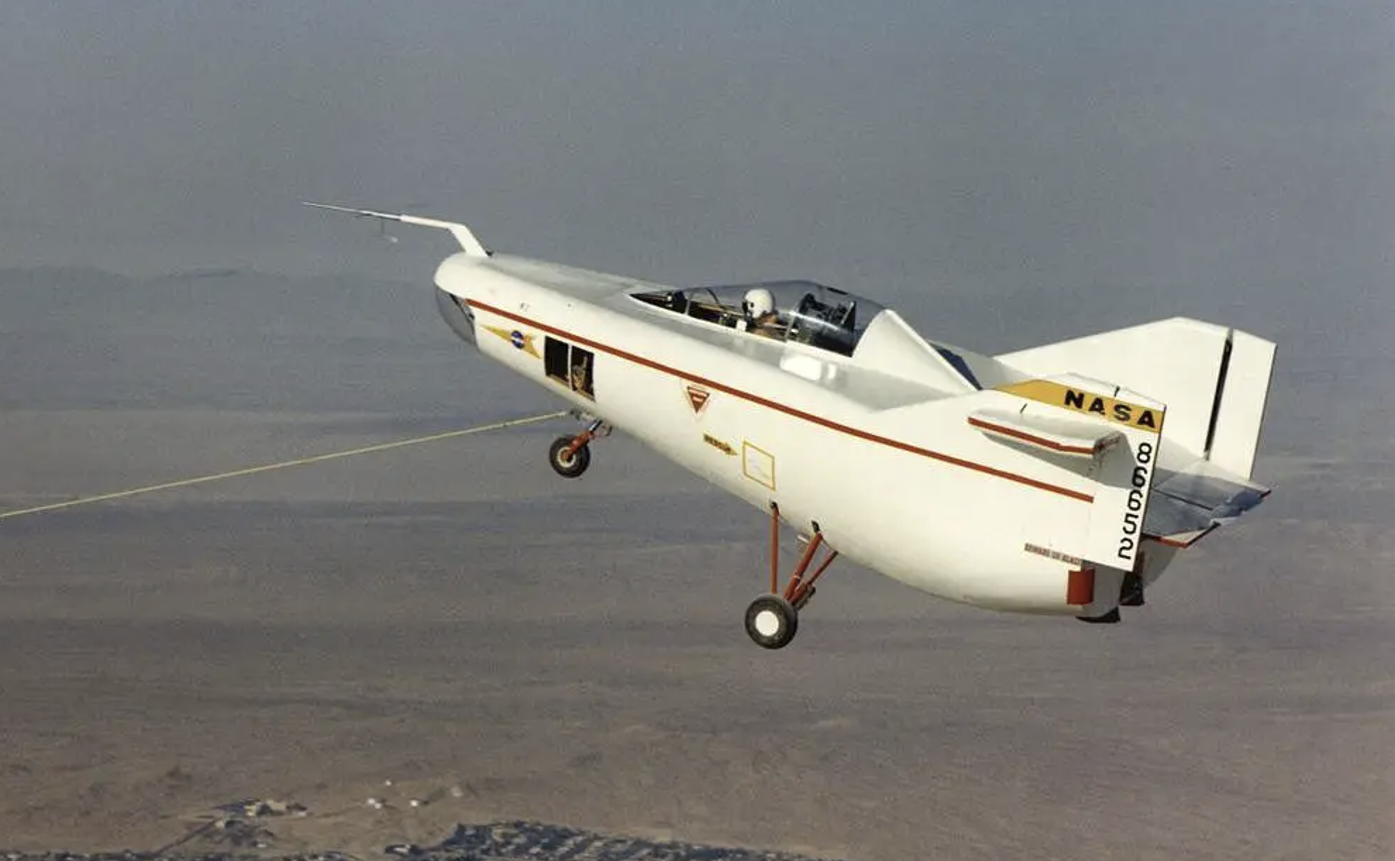
NASA M2-F1 Lifting Body
The NASA M2-F1 was an experimental lifting-body aircraft developed in the early 1960s to explore the concept of a wingless reentry vehicle. Built and tested by NASA’s Flight Research Center (now Armstrong Flight Research Center) at Edwards Air Force Base, the M2-F1 was designed to demonstrate that a properly shaped fuselage alone could generate sufficient lift for controlled atmospheric flight and landing. The program was part of broader research into spacecraft reentry and recovery concepts that could enable future reusable space vehicles.
Nicknamed the “Flying Bathtub” because of its rounded plywood fuselage, the M2-F1 was lightweight and inexpensive, constructed largely of wood over a steel-tube frame. Initial tests involved towing the aircraft behind a modified Pontiac convertible across Rogers Dry Lake to gather low-speed handling data. Later, it was air-towed to altitude by a C-47 aircraft and released for unpowered glide flights. Between 1963 and 1966, the M2-F1 completed more than 400 ground tows and 77 air tow flights, successfully proving the viability of the lifting-body concept.