
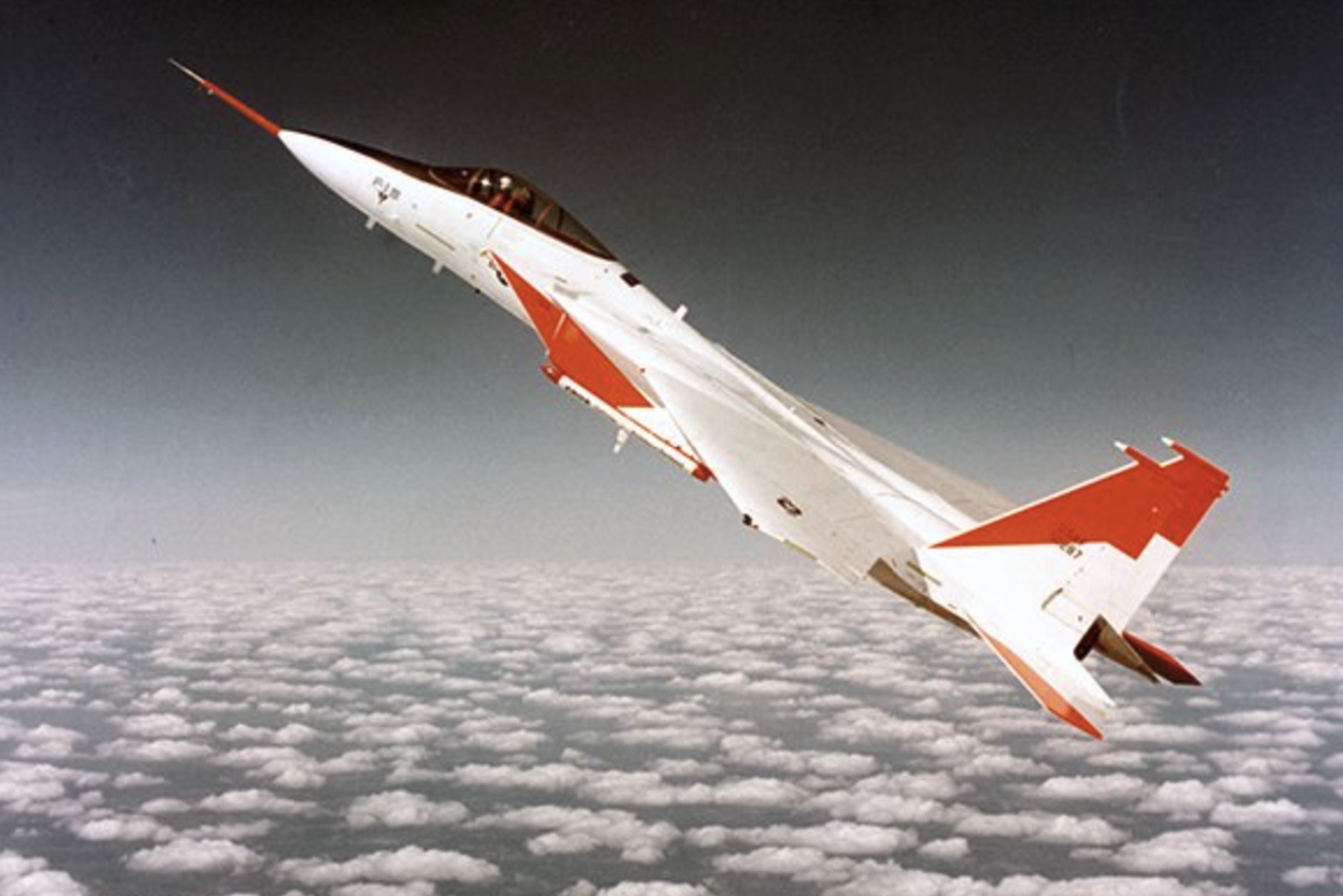
McDonnell Douglas YF-15A
On Display – Museum Airpark, Edwards AFB
The McDonnell Douglas YF-15A was the prototype aircraft developed by McDonnell Douglas in response to the U.S. Air Force’s F-X program in the late 1960s. The requirement emerged from lessons learned during the Vietnam War and growing concern over advanced Soviet fighters such as the Mikoyan-Gurevich MiG-25. The Air Force sought a dedicated air superiority fighter emphasizing high thrust-to-weight ratio, superior maneuverability, and advanced radar capability. McDonnell Douglas’ design was selected in December 1969, and two single-seat YF-15A prototypes were built to compete against the Northrop YF-17.
The first YF-15A flew on July 27, 1972, from Edwards Air Force Base, immediately demonstrating exceptional performance. Powered by twin Pratt & Whitney F100 engines, the aircraft featured a high-mounted swept wing, twin vertical stabilizers, and large leading-edge root extensions that enhanced lift and agility. During flight testing, the YF-15A achieved speeds above Mach 2.5 and showcased remarkable acceleration and climb rates, validating the Air Force’s concept of an energy-maneuverability-optimized fighter.
Following a successful competitive evaluation, the YF-15A was declared the winner in January 1975, leading to full-scale production of the F-15 Eagle. The prototype directly evolved into the operational F-15A/B and later variants, establishing one of the most successful air superiority fighters in history. The YF-15A’s design philosophy—prioritizing performance, radar capability, and air dominance—would shape U.S. fighter development for decades to follow.